
Losing a tooth changes more than your smile. It can make chewing harder, affect the way you speak, and put extra stress on the teeth around the gap. If you are weighing replace missing teeth options, the best choice usually comes down to three things – your oral health, your budget, and how permanent you want the solution to be.
For many patients, the hardest part is not knowing where to start. A missing front tooth may feel urgent because it affects appearance right away. A missing molar may seem easier to ignore, but over time it can lead to shifting teeth, bite changes, and bone loss in the jaw. That is why replacing a missing tooth is often about protecting your long-term oral health, not just restoring looks.
Why replace missing teeth options matter
When a tooth is missing, the surrounding teeth no longer have the same support. Neighboring teeth can drift into the empty space, and the opposing tooth may begin to move because it has nothing to bite against. Over time, that can create uneven wear, jaw discomfort, and areas that are harder to keep clean.
There is also the issue of jawbone loss. Tooth roots help stimulate the bone beneath them. When a tooth is gone, that stimulation decreases, and the bone in that area can begin to shrink. This is one reason some replacement choices do more than others to preserve oral health over the long term.
Not every patient needs the same treatment. Someone missing one tooth in an otherwise healthy mouth may be a strong candidate for a dental implant. Someone missing several teeth, or looking for a lower upfront cost, may be better served by a bridge or denture. The right plan is personal.
The main replace missing teeth options
Most patients will be choosing between dental implants, dental bridges, and dentures. Each option has real benefits, and each has trade-offs worth understanding before making a decision.
Dental implants
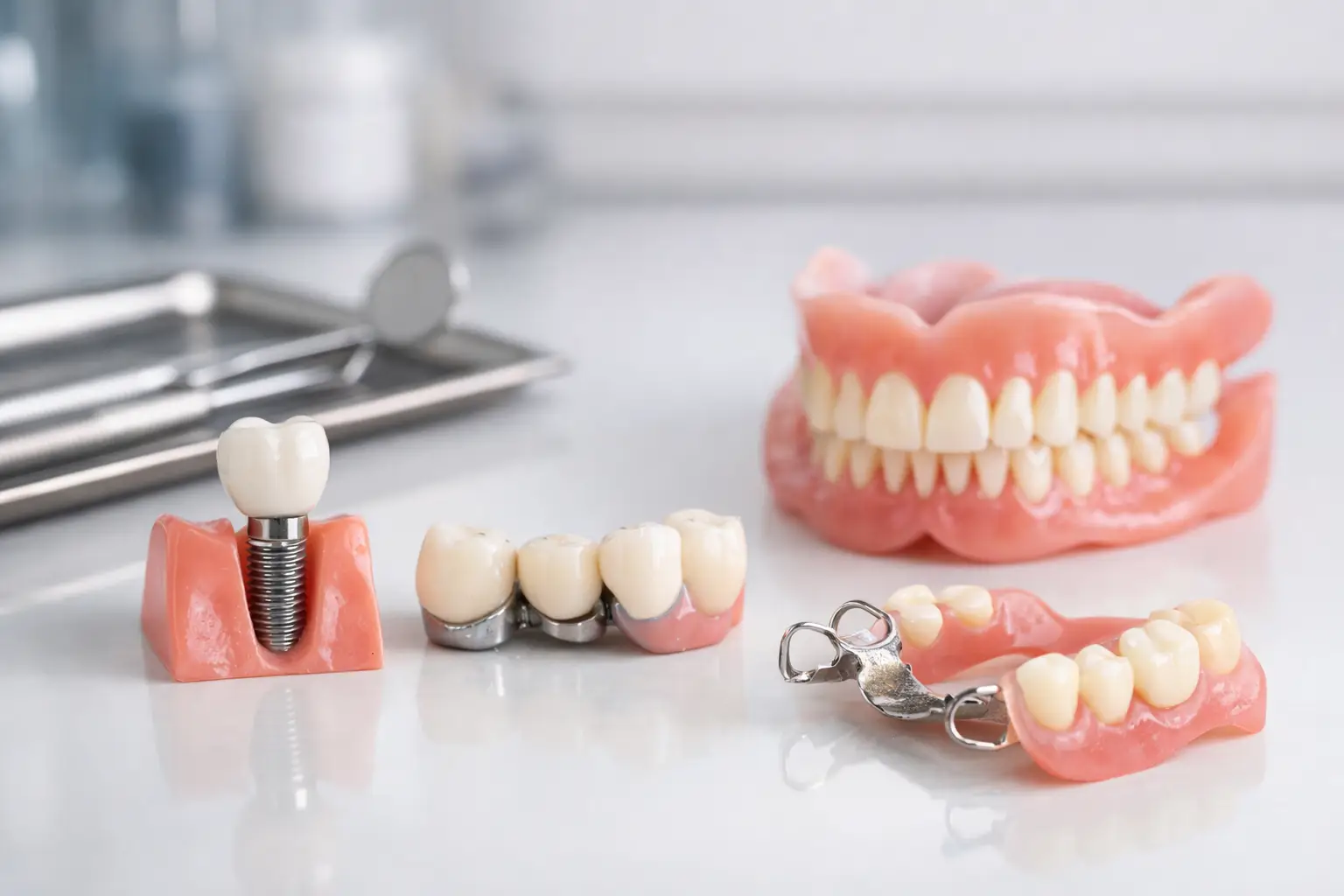
A dental implant is designed to replace the root of a missing tooth as well as the visible part above the gumline. A small titanium post is placed in the jawbone, where it heals and bonds with the bone. Once that process is complete, a custom crown is attached.
Implants are often considered the closest thing to a natural tooth. They look natural, feel secure, and do not rely on neighboring teeth for support. Because they stimulate the jawbone, they also help reduce bone loss in a way that bridges and dentures cannot.
The trade-off is that implants usually take more time and cost more upfront. Not every patient is an immediate candidate, especially if there is significant bone loss, active gum disease, or certain medical concerns. In some cases, bone grafting or other preparatory treatment may be needed first.
For patients who want a long-term solution and have the oral health to support it, implants are often a strong investment.
Dental bridges
A bridge fills the gap left by one or more missing teeth by anchoring an artificial tooth to the natural teeth on either side. Those supporting teeth are prepared and fitted with crowns, which hold the bridge in place.
Bridges are a reliable and well-established option. They are often completed faster than implants and may cost less upfront. For patients who want a fixed solution but are not ideal candidates for implant surgery, a bridge can be an excellent choice.
The main drawback is that a bridge depends on neighboring teeth. That means healthy teeth may need to be reshaped to support the restoration. A bridge also does not replace the tooth root, so it does not help preserve jawbone in the same way an implant does.
Still, for many busy adults and families looking for a practical, proven treatment, a bridge offers a good balance of function, appearance, and efficiency.
Partial dentures and full dentures
Dentures are removable appliances used to replace several missing teeth or a full arch of teeth. A partial denture fills multiple gaps while attaching around remaining natural teeth. A full denture replaces all teeth on the upper or lower arch.
Dentures are often the most budget-friendly way to restore a smile, especially when several teeth are missing. They can improve chewing, support facial appearance, and make everyday activities feel more comfortable.
They do come with an adjustment period. Some patients notice movement while eating or speaking, especially with traditional removable dentures. They also require regular maintenance and may need periodic adjustments as the shape of the gums and bone changes over time.
For patients who want more security, implant-supported dentures can be a strong middle ground. They combine the broader tooth replacement of a denture with the added stability of implants.
Which option is best for one missing tooth?
If you are missing a single tooth, the decision often comes down to an implant or a bridge. An implant is usually the most conservative long-term choice because it stands on its own and does not involve the teeth next to it. It also helps preserve bone.
A bridge may make more sense if the neighboring teeth already need crowns, if you want to avoid surgery, or if timing and upfront cost are your main concerns. Both can restore your smile well when planned carefully.
The location of the missing tooth matters too. A front tooth usually brings stronger cosmetic concerns, while a back tooth has to handle more chewing force. That is why a full exam, x-rays, and a bite evaluation are so important before choosing a treatment.
What if you are missing several teeth?
When multiple teeth are missing, there is often more than one workable solution. A few strategically placed implants may support individual crowns or bridges. A removable partial denture may be the more affordable path. If all or most teeth are missing, full dentures or implant-supported dentures are often discussed.
This is where treatment planning becomes especially important. The best answer is not always the most advanced treatment on paper. It is the one that fits your oral health, daily routine, comfort level, and financial reality.
For example, a working professional may want a fixed option that feels as close to natural teeth as possible. A retiree on a tighter budget may prefer a removable option that restores function without a major upfront investment. Neither choice is automatically right or wrong.
Cost, comfort, and convenience
For many patients, cost is one of the first questions, and understandably so. Implants usually cost more upfront, but they can offer excellent long-term value because they are durable and independent of neighboring teeth. Bridges often cost less initially but may need replacement over time. Dentures tend to be the most affordable starting point, though they may require adjustments, relines, or future replacement.
Comfort matters just as much. Some patients strongly prefer a fixed restoration that does not come out. Others are comfortable with a removable appliance if it means a lower cost or less invasive treatment. There is no one-size-fits-all answer.
Convenience also plays a role. Treatment timelines vary. A bridge may be completed faster than an implant. Dentures may offer a quicker path to restoring multiple missing teeth. If your schedule is packed with work and family responsibilities, that timing can matter.
How to choose with confidence
The best way to compare replace missing teeth options is to look at the full picture, not just the price tag. A treatment that seems cheaper today may not be the most cost-effective over time. A treatment that sounds ideal online may not be right for your bone level, gum health, or bite.
A good dental evaluation should cover the condition of your gums, jawbone, and remaining teeth, along with your goals. If you have dental anxiety, comfort should be part of the conversation too. Gentle care, clear communication, and modern technology can make treatment feel much more manageable.
At a full-service practice like Dental Care of Plano, patients often appreciate being able to discuss restorative options, comfort needs, scheduling, and affordability in one place. That can make the process feel less overwhelming, especially if you are balancing work, family, or a long to-do list.
Replacing missing teeth is not only about filling a gap. It is about helping you eat comfortably, speak clearly, protect your oral health, and feel more like yourself again. The right option is the one that supports your life now and your smile for years to come.